









The Social Neuroscience of Human Attachment: An Interview with Dr Pascal Vrticka

Introducing Dr Pascal Vrticka
Dr Pascal Vrticka, Associate Professor at the Department of Psychology, University of Essex (Colchester, United Kingdom).
Dr Vrticka is an Associate Professor and Principal Investigator of the Social Neuroscience of Human Attachment (SoNeAt) Lab within the Department of Psychology, University of Essex (Colchester, United Kingdom). After his initial BSc & MSc degrees in Science (specializing in Biology) from the Swiss Federal Institute of Technology (ETH) in Zurich, he obtained a PhD in Neuroscience from the University of Geneva. Dr Vrticka then held several postdoctoral and senior researcher positions at the University of Geneva, Stanford University School of Medicine, and the Max Planck Institute for Human Cognitive and Brain Sciences in Leipzig, Germany.
Dr Vrticka’s research focuses on the neurobiological basis of human relationships, attachment, and caregiving. With his work, he is promoting a new area of investigation – the social neuroscience of human attachment (SoNeAt). As coordinating board president of the Special Interest Research Group on the Social Neuroscience of Human Attachment (SIRG SoNeAt) and member of the executive board (Secretary) of the Society for Emotion and Attachment Studies (SEAS), Dr Vrticka furthermore participates in attachment theory development and refinement. One important goal that SIRG SoNeAt and SEAS share is to make attachment science more accessible to help resolve confusion and misconceptions associated with attachment theory and research. Being an associate trustee of the UK Charity Babygro, Dr Vrticka is also involved in translating his research to make it more accessible for parents, practitioners and organizations – check out their freely available Babygro Book and professional training courses. For more information, please visit Dr Vrticka’s personal website.
Dr Vrticka: What determines whether children develop secure, insecure, or disorganized attachment? Is it children’s DNA (i.e., their genetic code), the parenting (i.e., the immediate environment) children experience in early life, or a combination of the two? This is one of attachment theory’s and research’s central questions that taps into the heart of the nature versus nurture debate.
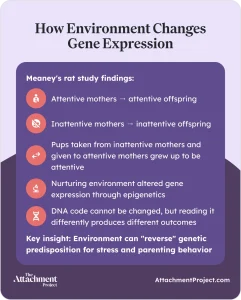
New insights from the field of epigenetics are starting to shed light on this debate, with the strongest evidence so far stemming from animal research. In a clever series of cross-fostering studies, Meaney and colleagues showed direct evidence for a nature by nurture interaction in that parenting can influence gene expression1.
The researchers took pups from two groups of rat mothers – attentive and nurturing (A&N) mothers and inattentive and non-nurturing (I&NN) mothers – and raised them in identical environments. Once these rats became adults and had pups, the researchers observed that rats taken from A&N mothers also became A&N mothers, whereas rats taken from I&NN mothers also became I&NN mothers. Furthermore, when the now adult rats were tested during a stressful situation, rats taken from A&N mothers showed a weaker stress response and less anxiety than those taken from I&NN mothers. Thus, to this point, there was evidence for a nature or genetic component that makes mothers more or less attentive and nurturing, and that links such behaviors to stress-sensitivity and anxiety.
Crucially, the researchers then repeated the experiment by taking rat pups from I&NN mothers and giving them to be raised by A&N foster mothers. Once this group of rats became adults and had pups, they showed attentive and nurturing mothering behavior. Furthermore, when tested in a stressful situation, these rats showed a similarly weak stress response and anxiety as the first group of rats taken from A&N mothers.
By investigating further, the researchers found that this stress-buffering influence of A&N mothering was acting through epigenetic changes that altered gene expression. In other words, even if rat pups were genetically predisposed to show I&NN mothering and higher stress-sensitivity and anxiety (because they had inherited I&NN genes), a protective and nurturing early environment could “reverse” this predisposition. Importantly, this environmental influence of nurture did not act on the DNA or genetic code itself – because the latter cannot be changed. However, it altered how the genetic code was read, how much of a protein that is an important player in the stress response was being produced, and thereby influenced rats’ neurobiology and behavior.
A great short animated video by the University of Oslo Faculty of Medicine illustrating the above nature by nurture interaction is freely accessible on YouTube2.
In humans, it is much more difficult to study the neurobiology of nature and nurture in the context of parenting and attachment. However, there is growing evidence that similar mechanisms–as shown by Meaney and colleagues in rats–may be at play3. For example, in a small preliminary study in 109 young adults, we were able to show that self-reported attachment insecurity, and specifically avoidance, was related to epigenetic changes in two genes involved in both the stress response and social stress regulation4. More research in our own and other labs is currently underway to extend such initial evidence in humans by also looking at epigenetic patterns in children over longer time periods (e.g., from birth to age 10) and to directly link it to child attachment.
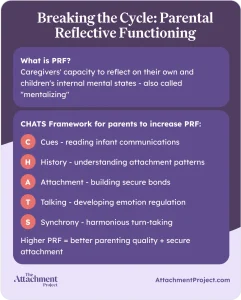
Dr Vrticka: In the context of parenting and parent-child interactions, parental reflective functioning (PRF) refers to caregivers’ capacity to reflect upon their own as well as their children’s internal mental experiences and states – a capacity also known as “mentalizing.” Mentalizing involves understanding one’s own as well as others’ feelings, desires, wishes, goals, and attitudes, and thereby making sense of behavior.
Unsurprisingly, the assumption is that parents with higher PRF are better able to support their children’s development, in general, and their capacity for mentalizing more specifically. In doing so, children become more proficient in emotion regulation, acquire a better sense of personal agency, and are more likely to establish secure attachment relationships. A central mechanism which is therefore attributed to adequate mirroring of and reflection upon children’s subjective experiences by parents.
In a recent systematic review across 16 studies and over 1000 parent-child dyads, PRF was found to show a positive association with overall parenting quality5. Another meta-analysis across 20 studies and almost 1000 observations furthermore revealed that PRF is not only positively correlated with infant-parent attachment security, but also with parental sensitivity6. In other words, PRF seems to increase parenting quality and infant-parent secure attachment in part through heightened parental sensitivity. Accordingly, it appears to be beneficial for parenting quality and child development if PRF is high or if it can be increased.
A good starting point for parents to learn about the prerequisites of PRF and parental sensitivity is our Babygro Book that can be downloaded online for free7. The Babygro book is built around five evidence-based components for optimal parent-child communication and interaction, summarized as CHATS, which all describe ways to increase PRF and parental sensitivity.
CHATS first illustrates how parents can become proficient at reading and responding to their infants’ cues and communications. It then delves into attachment theory by encouraging parents to understand both their own attachment history as well as how infant-parent attachment is formed. Subsequently, the book shows how talking to infants can help build their understanding of the self and others as well as their emotion regulation skills. Finally, it mentions how the four above CHATS components are affected by parent-infant synchrony – harmonious turn-taking and emotional attunement. Importantly, the Babygro Book’s focus is less on prescribing parenting advice and more on providing a direct line to the latest research findings. We hope that, in this way, parents can feel empowered about the parenting choices they make.
Should a more targeted and intense PRF (and parental sensitivity) enhancement be necessary, there are a few interventions that have already been tested and show promising initial results, including “Minding the Baby” and the “Mothers and Toddlers Program (MTP) treatment model”8, 9. Another avenue for parents is to engage in Mentalization Based Therapy (MBT) for parents, which is a specific type of psychotherapy developed specifically for parents experiencing complex difficulties10.
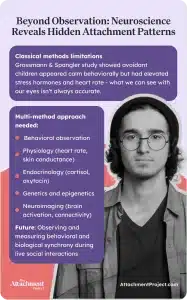
Dr Vrticka: Employing social neuroscience methods in attachment research not only adds value but is necessary to capture the highly complex nature of human attachment. Classical attachment assessment methods, including behavioral observation, interviews, and self-reports, remain indispensable. However, they should be complemented by measures of physiology (e.g., heart rate, skin conductance), endocrinology (e.g., secretion of hormones like cortisol and oxytocin), genetics and epigenetics, as well as neuroimaging (e.g., brain activation, structure, connectivity, and interpersonal neural synchrony) that add further pieces to the overall puzzle.
A great example is the seminal 1993 study by Grossmann & Spangler11 in which the authors, for the first time, combined behavioral observation in children with measures of physiology (heart rate) and endocrinology (cortisol from saliva) as part of the Strange Situation Procedure. As expected, insecure-avoidant children showed less behaviourally observable distress after short separations from their mothers. However, heart rate and cortisol data revealed a different story, namely increased physiological arousal and elevated secretion of stress hormones and thus the lack of an appropriate coping strategy. With this study, attachment researchers not only learned that some characteristics of insecure attachment cannot be captured by behavioral observation alone, but that observational data may sometimes be quite different from, or even opposite to objective physiological and endocrinological data.
During the last 30 years, our knowledge of the social neuroscience of human attachment has steadily grown. We recently summarized the so far available literature in our first functional neuro-anatomical models of organized and disorganized/disrupted attachment (NAMA and NAMDA12). We think that the data point to a crucial role of attachment for energy conservation through co-regulation – i.e., which strategies we use to seek and obtain support from others when we are in need, and what we do if our social resources are unavailable, unpredictable, or become a threat by themselves13.
So far, most of the available social neuroscience data on human attachment was obtained from single participants in isolation. However, attachment is an inherently interpersonal process that unfolds during direct and live social interaction. One future avenue of social neuroscience research on attachment therefore will be to obtain neurobiological data from two (or more) participants while they naturally interact with one another. A novel measure that starts emerging from such experimental setups is bio-behavioural synchrony – i.e., the alignment of behavior, physiology, endocrinology, and brain activation across participants in time. We already looked at bio-behavioural synchrony from an attachment perspective in parent-child dyads including both mums and dads within our CARE studies, and are currently expanding our focus to mother-child-father triads, dyads of romantic partners, and families with neurodiverse children14, 15.
Dr Vrticka: There is consistent evidence that attuned, sensitive and reflective parenting yields more secure child attachment and better socioemotional child developmental outcomes. All these factors are an integral part of reciprocal parent-child interactions marked by high amounts of turn-taking and thus bio-behavioral synchrony. I have commented on these relations in my previous answers.
A pioneer in the area of bio-behavioral synchrony research and theory building is Ruth Feldman. She has published numerous articles on the importance of synchrony for the parent-child bond and child development. Importantly, her work covers mothers and fathers, as well as non-biological and non-gestational parents, and includes many longitudinal studies sometimes following children and parents for several decades. An excellent review article on bio-behavioral synchrony and the parent-child relationship including considerations relevant for attachment can be found here.
Another influential researcher in the area of BBS (bio-behavioural synchrony) is Shir Atzil who has developed an evolutionary theory of social affiliation. Shir proposes a unifying principle that motivates and shapes social bonding across the lifespan in social species, like us humans. This principle is social allostasis – or the co-regulation of our metabolic states.
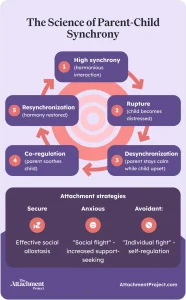
In children, social allostasis depends upon close physical contact with their caregiver(s) and works best through sequences of rupture and repair that involve states of high synchrony, desynchronization and resynchronization. For example, if children become upset, an initially harmonious and synchronous parent-child interaction becomes an interaction within which the parent needs to co-regulate the child and thus to provide resources for the child’s social allostasis. In doing so, the parent will need to – in an attuned and sensitive manner – create an opposite emotional and mental state to their child. To give an example: If the child starts crying, it would not help if the parent starts crying as well. Rather, the parent will try to soothe the child by remaining calm and offering security and care. There will thus be a certain desynchronization in the parent’s and child’s neuropsychological and behavioral variables. If co-regulation succeeds and children can make use of social allostasis resources provided by their parent, we would expect a subsequent resynchronization.
The above process of parent-child co-regulation and social allostasis is intricately linked to attachment. It is our primary attachment strategy to seek proximity to available and responsive caregivers under distress, because they provide us with social resources for allostasis. However, if our social resources for allostasis are reduced or it is difficult to predict their availability, we must start employing compensation mechanisms, also known as secondary attachment strategies. These are either linked to an upregulation of our own regulatory resources, which we call “individual fight” and link to attachment avoidance, or to an upregulation of support-seeking attempts, which we call “social fight” and link to attachment anxiety. Finally, if our social resources become completely unavailable (associated with neglect) or even a source of fear and threat (associated with abuse / maltreatment), our compensation mechanisms will become extreme and much more rigid. We associate these with tertiary attachment strategies of disorganization. A summary of the above considerations can be found here.
So far, most research on bio-behavioral synchrony has been trying to establish when there is a high amount of synchrony, because more synchrony is thought to be always better. As explained above, however, successful rupture and repair interactions will also involve states with lower synchrony, which are necessary for co-regulation to work. Furthermore, in situations of high stress and negative emotions, increased synchrony may fuel the propagation of unhealthy and unhelpful states. We should therefore rather think of synchrony as having an “optimum midrange”18, where it is most beneficial for social interaction, and more negative or even detrimental effects both when synchrony is too low or too high. More research is needed to look into bio-behavioral synchrony also during stress to better understand its benefits but also pitfalls.
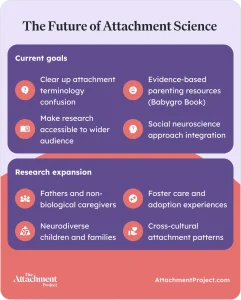
Dr Vrticka: Attachment science and theory have seen many important developments during the last years. Unfortunately, there remains extensive confusion about attachment terminology and concepts between researchers, practitioners, parents, social media users, etc. This is due to fact that many of the concepts used by attachment researchers take terms from ordinary language but ascribe them technical meanings. Also, the many recent innovations within our field have often not been made accessible to a wider audience, which precluded a mutual dialogue and further increased the feeling of getting lost in translation. Together with the Society for Emotion and Attachment Studies (SEAS), I am trying to improve this situation. For example, I always refer interested individuals to the excellent Explanations Of Attachment Theoretical Concepts compiled by several SEAS members16. I have also started three Attachment Myth-Busting, Attachment Q & A as well as Attachment Science series on my website and on my social media accounts. I am furthermore promoting a social neuroscience approach to attachment that not only adds value but is crucial to fully understand the complex nature of human attachment. I hope that these combined efforts will help to highlight the many relevant and important contributions attachment science and theory make for comprehensively understanding human relationships, caregiving and attachment.
Associated with the above is my goal to provide parents, practitioners and organizations with state-of-the-art evidence-based information regarding parent-child relationships and child development from an attachment science and theory perspective. To do so, I am collaborating with the UK Charity Babygro that recently released the free-of-charge Babygro Book and is now starting to set up online as well as in-person professional training – besides the already running local workshops for parents7. Crucially, our focus is less on prescribing parenting advice and more on providing a direct line to the latest research findings. We hope that in this way, parents can feel empowered about the parenting choices they make. It would be great to see more parents, practitioners and organizations becoming aware of Babygro’s work because the feedback we have received so far has been overwhelmingly positive.
I would also like to see an even stronger focus of both attachment research and theory on fathers and other non-biological and non-gestational caregivers, and on the important role they play as attachment figures for their children. This also includes translating and communicating any associated findings and theoretical implications, as I have already started doing on my Caring Dads website section17.
Finally, I am currently extending my social neuroscience of attachment research to families with neurodiverse children and to children with experiences of foster care or adoption. I would also like to engage more strongly in cross-cultural research and more generally include participants from as many different personal and cultural settings as possible.
 Get mental health tips straight to your inbox